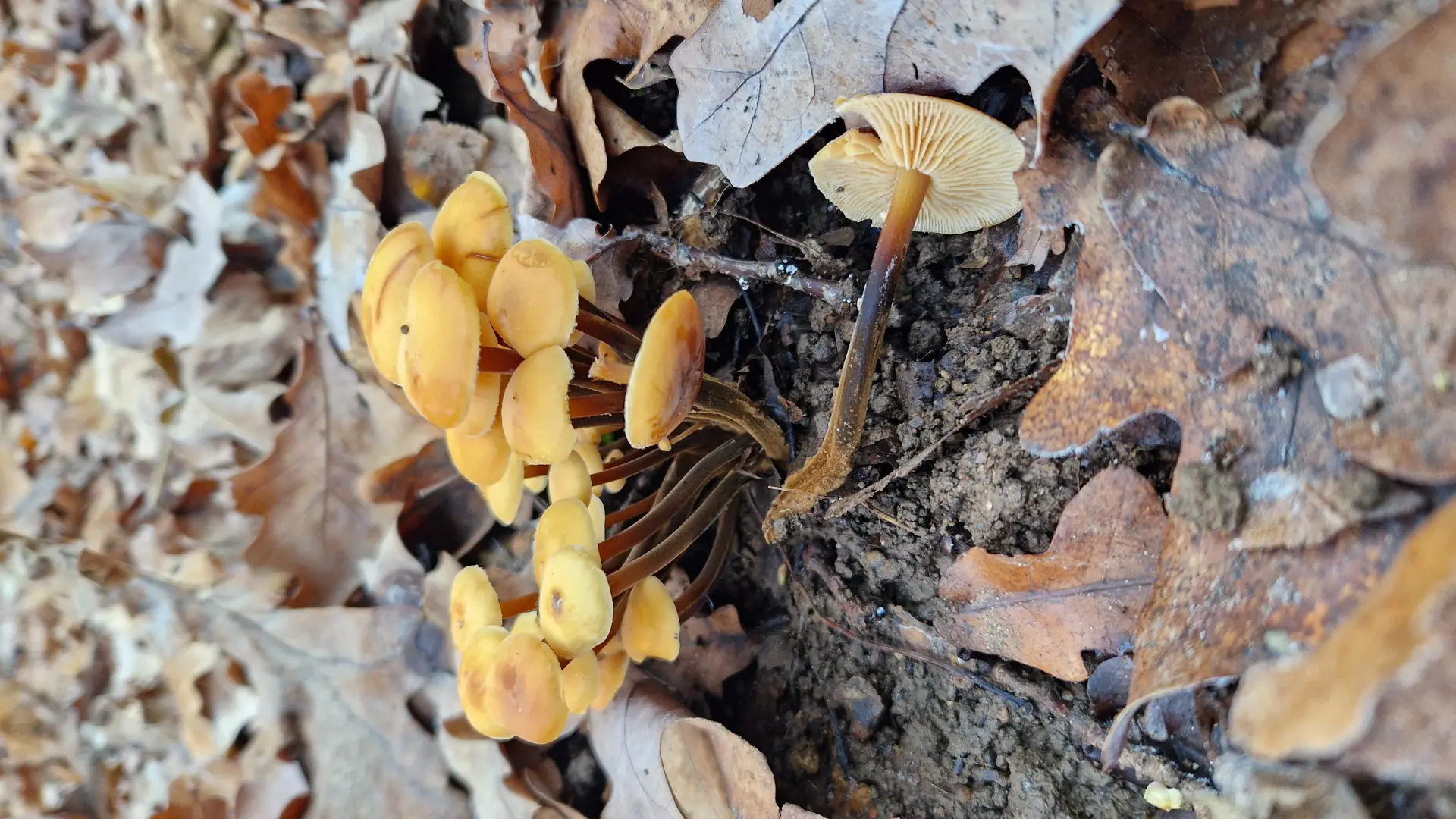
Velvet Shank
Flammulina velutipes
Identification of Velvet Shank (*Flammulina velutipes*)
1 / 4
Toutes les images (4)
Caractéristiques clés
- Viscid
- slimy
- yellow-orange to tawny cap
- Grows clustered on wood (stumps
- logs
- roots)
- Stem tough
- slender
- dark brown to blackish at base
- Stem base covered in fine
- dark velvet hairs (velutinous)
- Fruiting occurs late autumn through winter
Couleur :
Yellow-orange (cap), pale cream (gills), dark brown/black (stem base)
Odeur :
No distinctive smell
Mode de croissance :
Clustered
Environnement :
Wood
Habitat et distribution
Habitat :
Deciduous forests, growing on hardwood logs, stumps, or buried roots
Distribution :
Widespread across temperate regions of the Northern Hemisphere
Saisonnalité :
Late Autumn, Winter
Valeur économique
Demande du marché :
High - The cultivated form ('Enoki') is widely consumed globally.
Gamme de prix :
$5-15/lb fresh (cultivated)
Usage commercial :
Cultivated commercially as a food source (Enokitake)
Espèces similaires
Deadly Galerina
Galerina marginata
Différences clés :
- Has a distinct membranous ring (annulus) on the stem
- Stem is uniform brown, not velvety black at the base
- Spore print is rusty brown (F. velutipes is white)
Sulphur Tuft
Hypholoma fasciculare
Différences clés :
- Gills are greenish-yellow when mature
- Cap is typically sulfur yellow, not orange-brown
- Stem lacks the dark, velvety base
Action recommandée
Do not consume. If consumption is considered, definitive identification by a certified mycologist is mandatory due to the presence of deadly lookalikes.